Introduction
Building a RoboSumo robot is only the beginning.
Once the basic robot is working, the next question is:
How can the robot be made faster, stronger, more responsive and better suited for the arena?
The answer isn’t always to completely rebuild the robot.
Small changes to the motors, wheels, motor drivers, electronics, programming and overall control strategy can significantly change how a RoboSumo behaves.
If you're still building your first RoboSumo, start with the complete step-by-step RoboSumo robot building guide before moving on to upgrades.
This guide explores several upgrade paths that participants can experiment with while preparing for the OLL × TechFest Robotics Championship.
The important thing is to treat every upgrade as an experiment:
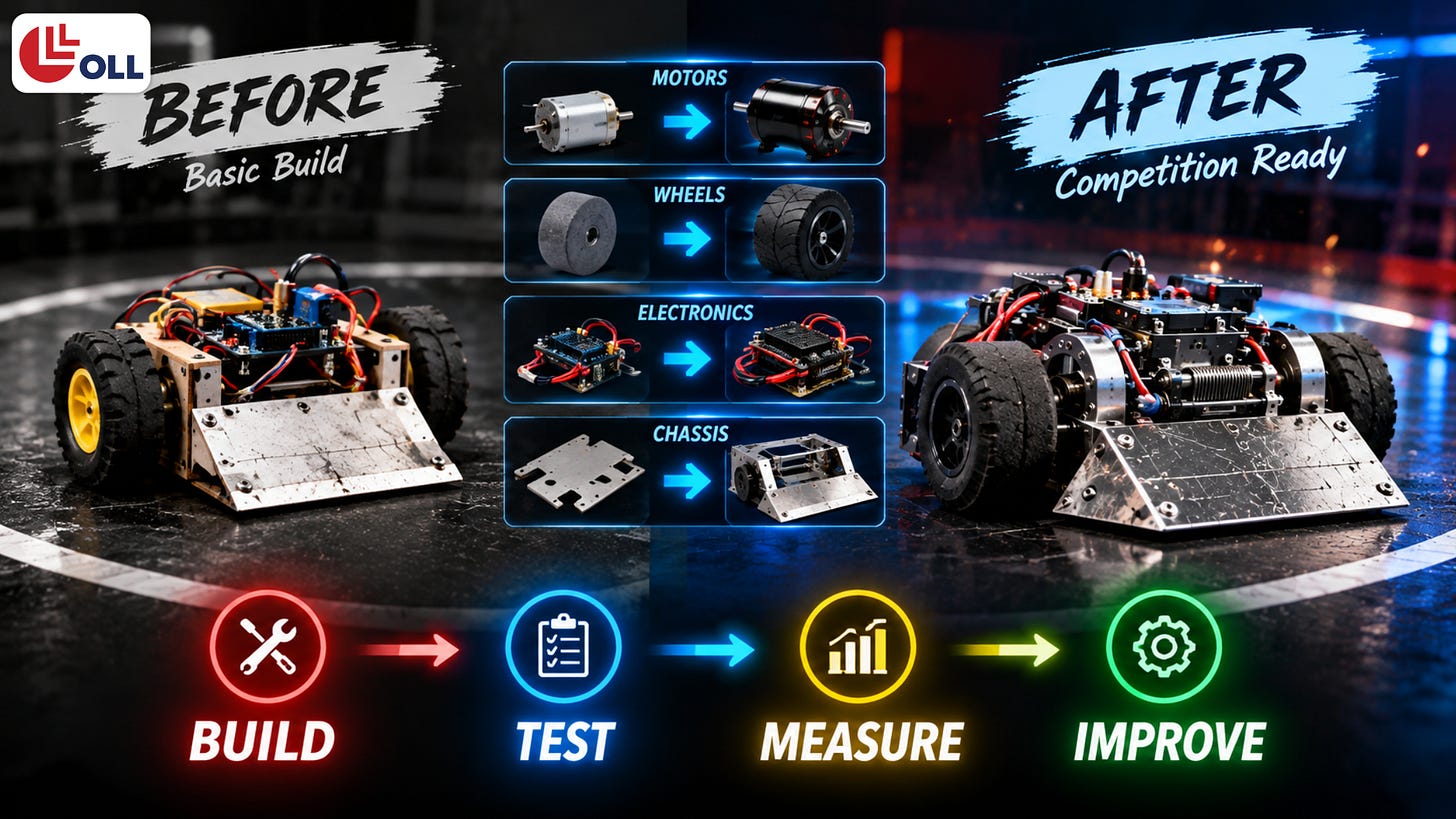
Build → Test → Measure → Improve → Repeat.
⚠️ Important: Any modification made to a competition robot must comply with the latest official RoboSumo rules, including permitted dimensions, weight, battery voltage, construction and mechanisms. The ideas below are experimentation and upgrade suggestions, not guarantees of winning.
🤖 Participate in the OLL × TechFest Robotics Championship
Ready to put your RoboSumo skills to the test? Explore the OLL × TechFest Robotics Championship 2026–27, where school students can build, compete and showcase their robotics skills.
The championship features RoboSumo, RoboRacer and the Robotics Innovation Challenge, with the journey leading towards the Grand Finale at IIT Bombay.
👉 Explore the OLL × TechFest Robotics Championship
The 8 Pillars of RoboSumo Upgrades
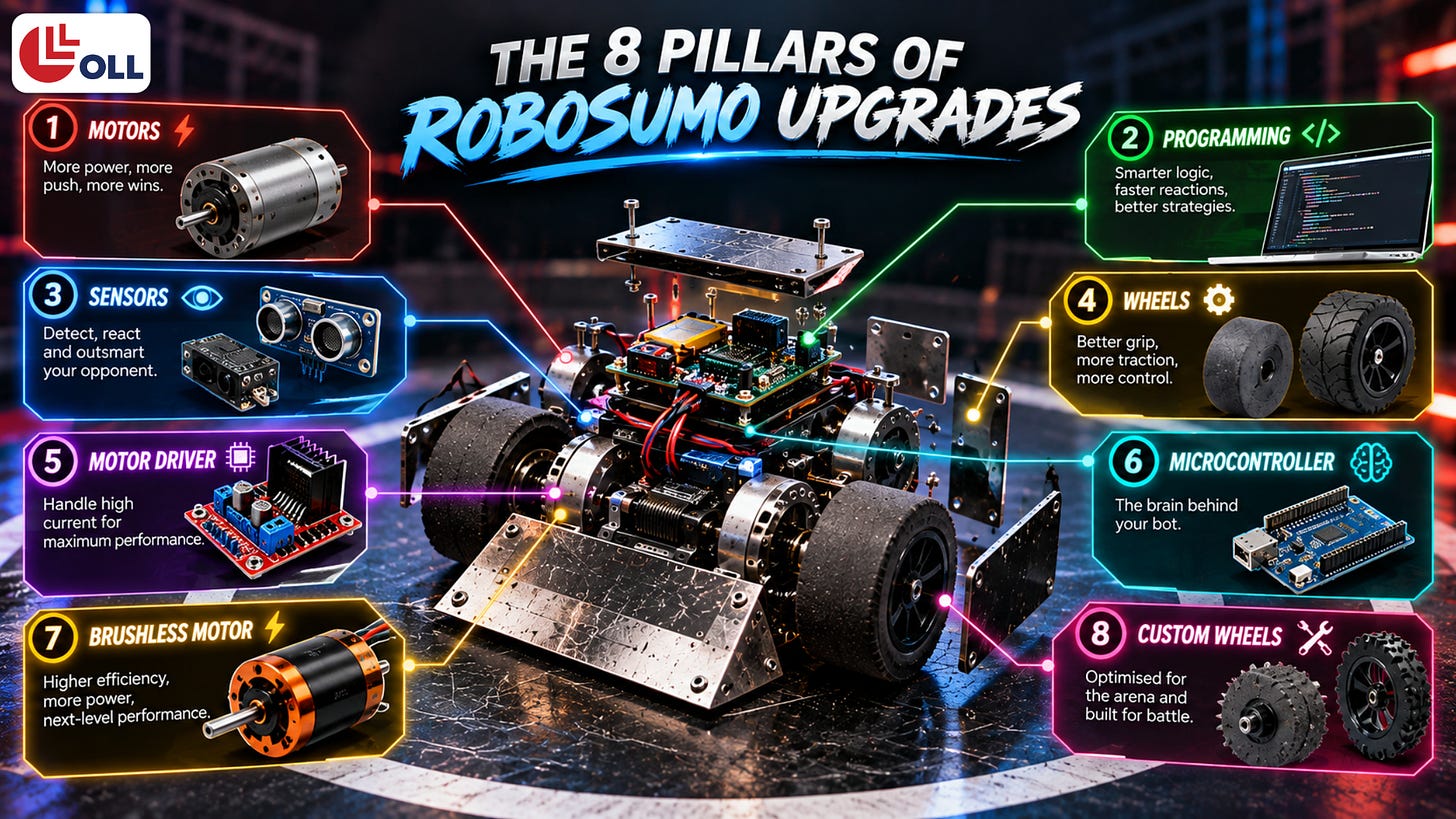
A RoboSumo can be improved in several different ways. Instead of looking for one “magic” upgrade, participants can think about the robot through these eight pillars:
⚡ Motors
💻 Programming & Control
👁️ Sensors & Autonomous Control
🛞 Wheels & Traction
🔌 Motor Drivers
🧠 Microcontroller
🔋 Motor Technology
🛠️ Custom Wheel Design
Let’s look at each one.
Always check the official RoboSumo competition rules before modifying a competition robot.
1. ⚡ Experiment With Different Motors
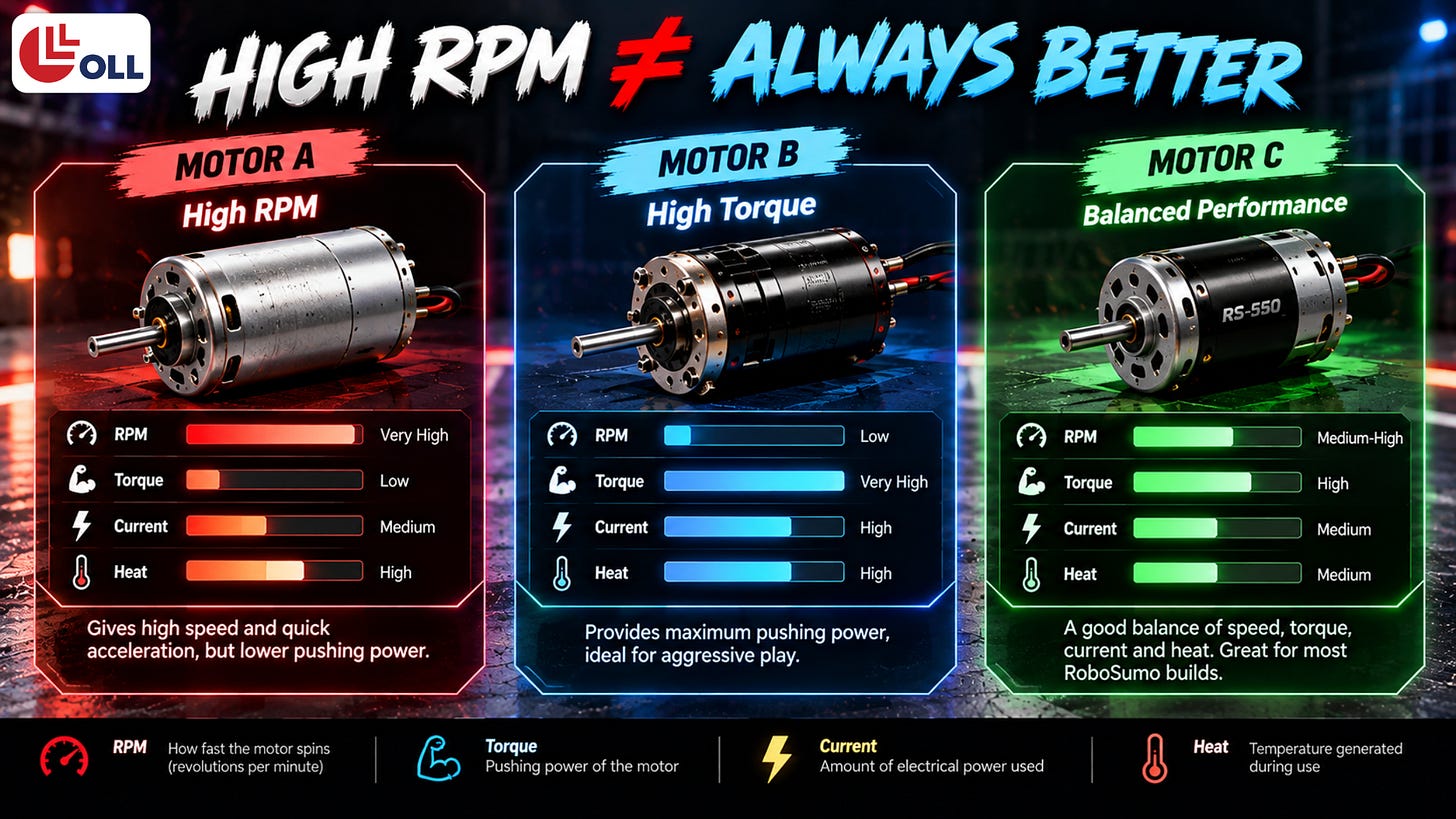
The motor is one of the most important components of a RoboSumo.
It determines how quickly the robot can accelerate and how much torque it can produce at the wheels.
A robot with a high-RPM motor may be able to move quickly, but speed isn’t everything in RoboSumo.
During a push, torque and traction can matter just as much.
Participants can experiment with different motors and compare:
RPM
Torque
Current consumption
Acceleration
Motor size
Weight
Heat generated during operation
For example, one motor may provide higher speed while another may provide better low-speed torque.
The goal isn’t simply to choose the motor with the highest RPM.
The real question is:
Which motor gives the best overall performance for the robot’s weight, wheels and power system?
Test different combinations and measure how the robot performs.
2. 💻 Optimise the Code
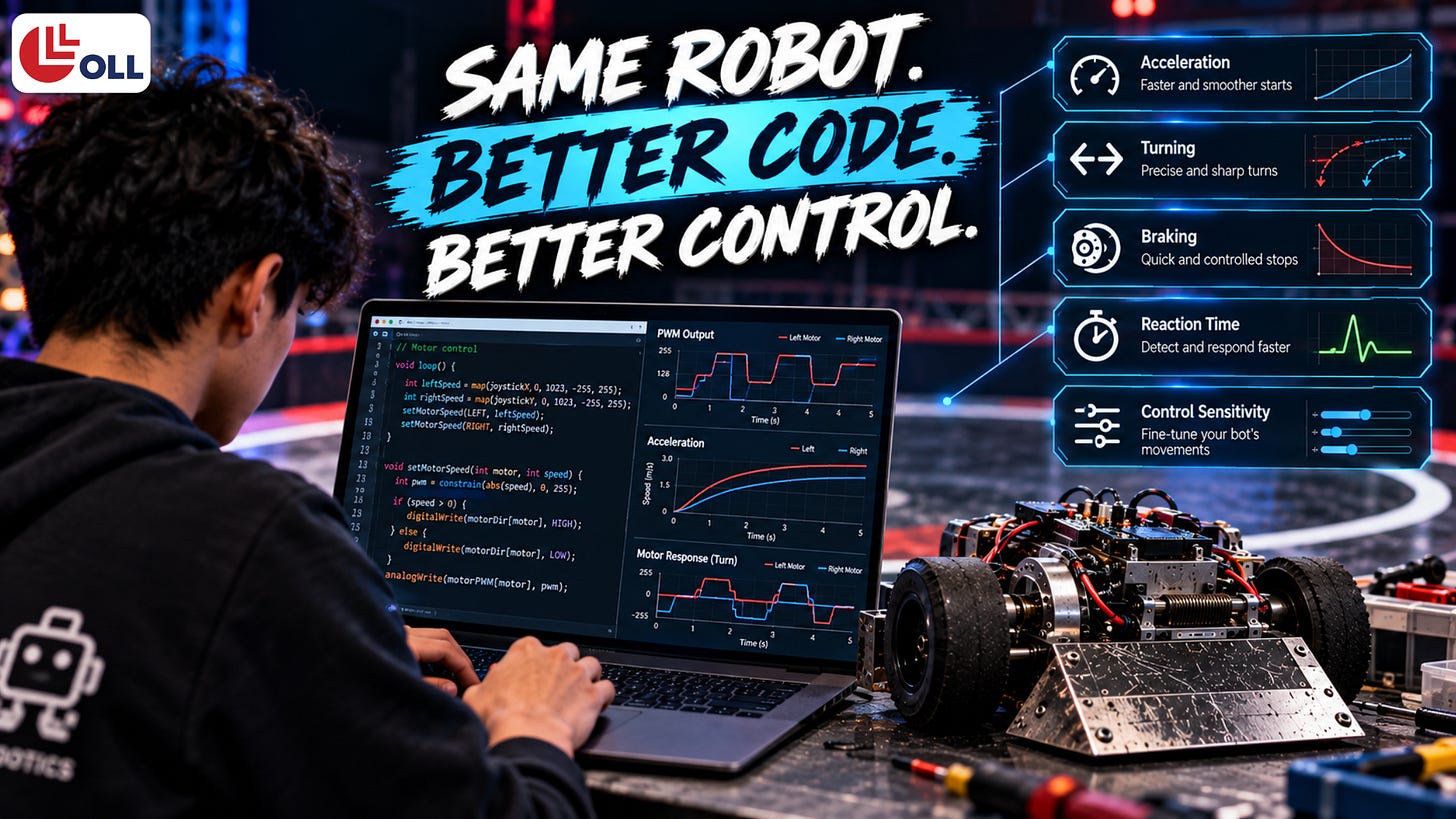
Hardware isn’t the only thing that can make a RoboSumo better.
The control code can completely change how the robot behaves.
Even with the same motors and electronics, changes to the program can improve:
Acceleration
Turning response
Motor speed
Direction changes
Reaction time
Braking
Control sensitivity
For example, instead of immediately running the motors at maximum power, the program can be adjusted to create a smoother acceleration profile.
Similarly, different control values can be tested to make the robot respond faster when changing direction.
Try this:
Create different versions of the control program and test them under the same conditions.
For example:
Version A: Maximum speed
Version B: Controlled acceleration
Version C: Faster turning response
Version D: Optimised left/right motor balance
Then compare the results.
The fastest code isn’t necessarily the best code.
The best code is the one that gives the driver the control needed during an actual match.
3. 👁️ Experiment With Autonomous Control
Another interesting upgrade path is experimenting with autonomous behaviour.
Participants can explore sensors such as the HC-SR04 ultrasonic sensor to detect objects in front of the robot.
The basic concept is simple:
Sensor detects an object → Microcontroller processes the distance → Robot responds.
For example, a program could be designed to detect an object within a particular distance and change the robot’s movement accordingly.
This can be an excellent way to learn about:
Sensors
Distance measurement
Decision-making
Conditional programming
Autonomous robotics
But there is an important competition consideration.
Before using an autonomous system in an actual competition match, participants must verify that the latest RoboSumo rules permit that control method.
So think of autonomous control as an advanced experimentation pillar rather than assuming it is automatically competition-legal.
4. 🛞 Try Bigger or Different Wheels
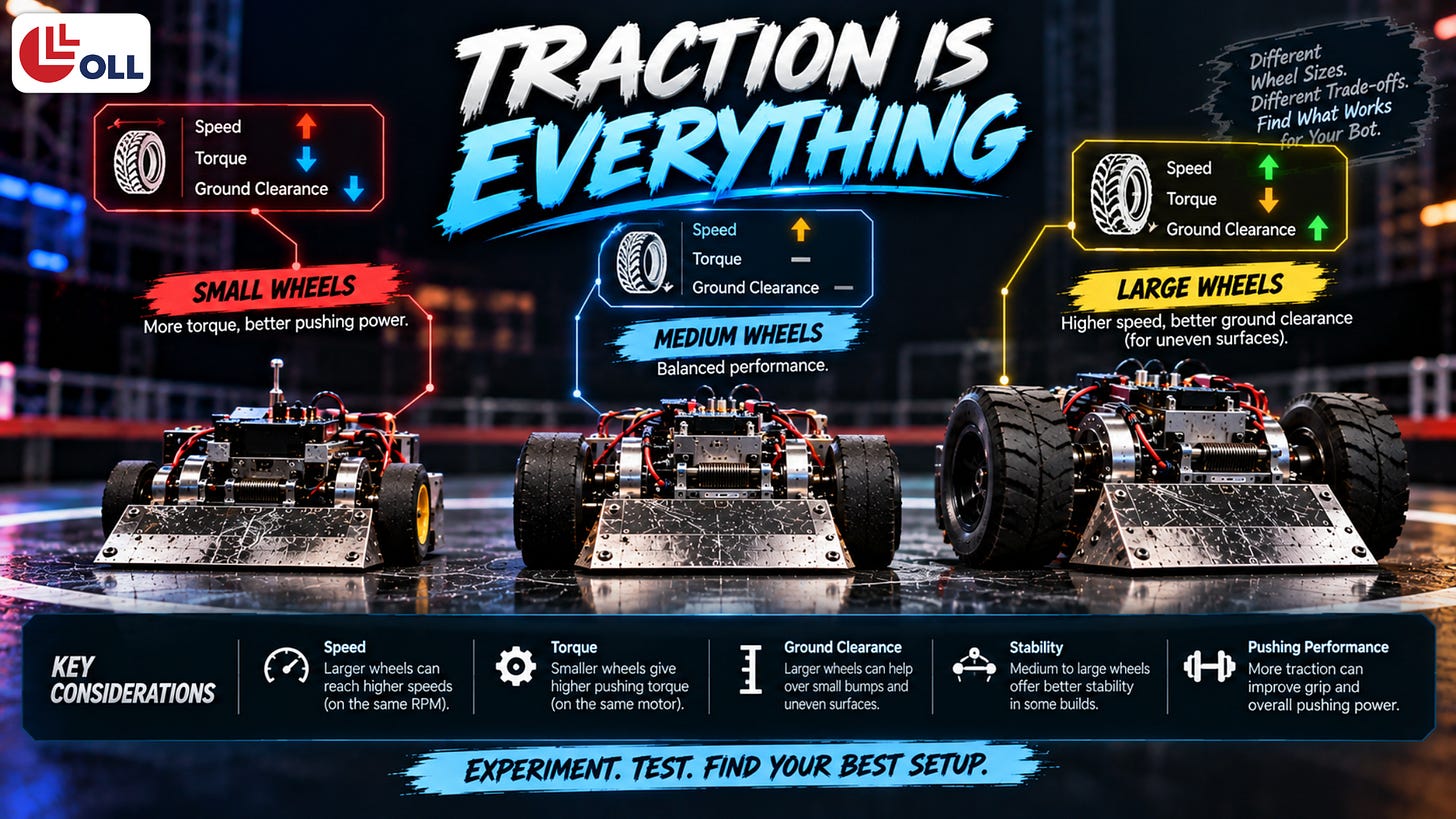
The wheels are the robot’s connection to the arena.
Changing the wheel size can change the behaviour of the entire robot.
Larger wheels can affect:
Ground clearance
Speed
Acceleration
Obstacle handling
Motor load
But bigger doesn’t automatically mean better.
A larger wheel can also change the torque available at the ground and may affect the robot’s stability.
Participants should experiment with different wheel sizes and compare:
Acceleration → Top Speed → Traction → Stability → Pushing Performance
Most importantly, the wheels must remain within the competition’s dimensional and mechanical requirements.
5. 🔌 Experiment With Different Motor Drivers
The motor driver acts as the bridge between the controller and the motors.
The standard motor driver can be replaced during experimentation with alternatives such as:
L298N
A commonly used motor driver that is easy to understand and experiment with.
Cytron MD30C
A higher-current motor driver designed for more demanding motor applications.
Different drivers can provide different characteristics in terms of:
Current handling
Efficiency
Heat generation
Motor response
Wiring
Protection features
However, simply installing a more powerful motor driver won’t automatically make the robot faster.
The motor, battery, driver and control system must all be compatible.
And before using any alternative component in the actual competition robot, its specifications and compliance should be checked against the official rules.
6. 🧠 Experiment With a Different Microcontroller
The microcontroller is effectively the brain of the robot.
The ESP32 is a powerful option, but participants can experiment with other development boards to understand how different control platforms behave.
For example:
STM32 Blue Pill
A compact STM32 development board that can be used to experiment with embedded control.
STM32 Black Pill
Another STM32-based development platform that provides a different hardware and programming environment.
Switching microcontrollers can help students explore:
GPIO control
PWM
Motor control
Interrupts
Real-time programming
Embedded systems
However, changing the MCU also means rewriting or adapting the control program.
So this is an upgrade for participants who want to go beyond the basic build and experiment with embedded programming.
7. ⚡ Experiment With Brushless Motors
Want to explore something more advanced?
Participants can experiment with brushless motors.
Brushless motors are widely used in applications where high power-to-weight ratios and high efficiency are important.
However, moving from a brushed DC motor to a brushless system is not a simple motor swap.
A brushless setup generally requires an appropriate electronic speed controller (ESC) and a compatible power and control system.
That means participants need to understand:
Motor → ESC → Controller → Battery
They also need to consider:
Torque characteristics
Low-speed control
ESC compatibility
Battery requirements
Current consumption
Weight
Heat management
This makes brushless motors an excellent advanced experimentation project, but they should only be used in competition if the complete setup complies with the official rules.
8. 🛞 Try Designing Your Own Wheels
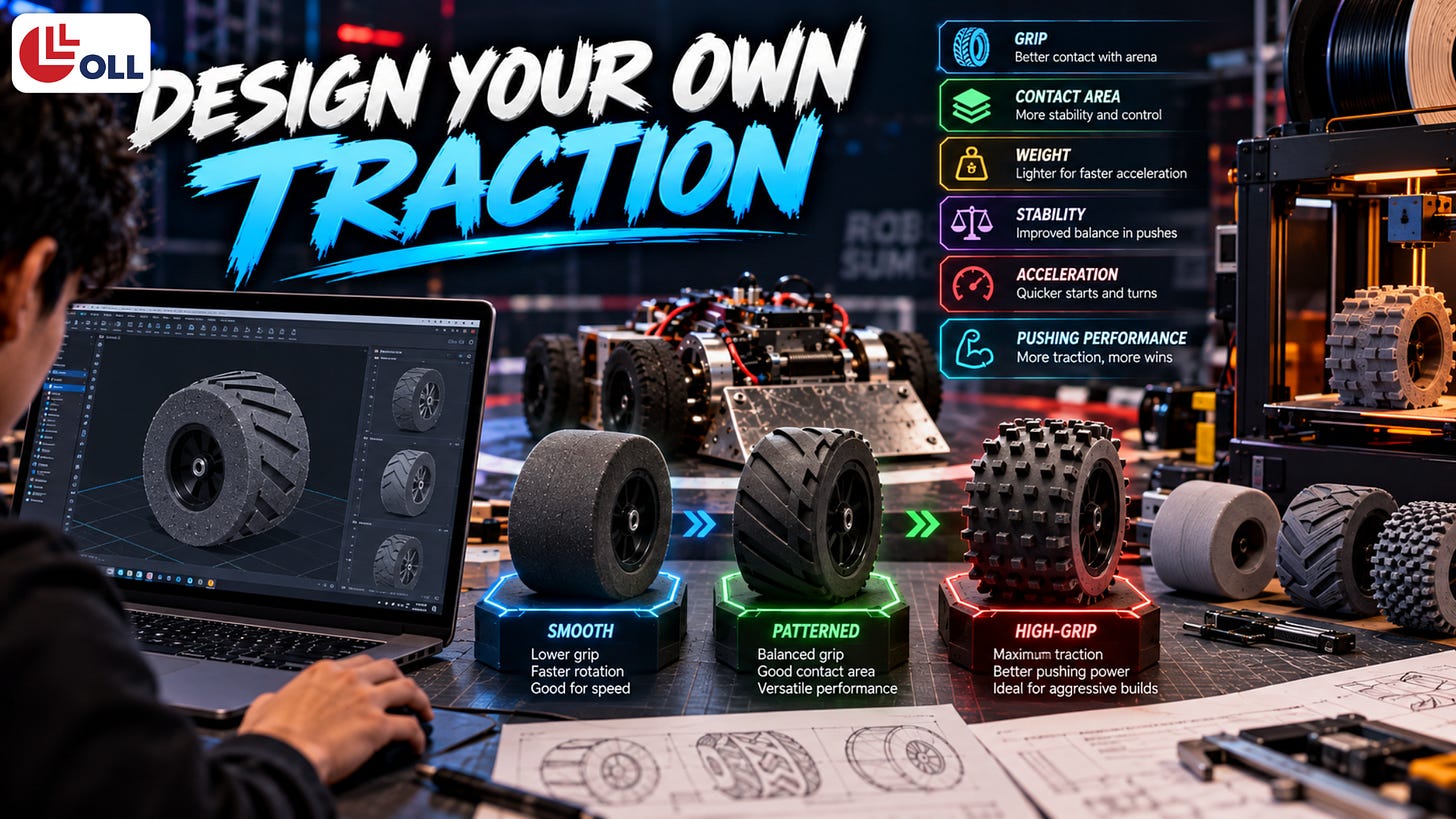
One of the most interesting upgrades is to experiment with custom wheel designs.
Instead of simply purchasing a standard wheel, participants can explore designing their own wheel geometry.
The wheel design can affect:
Grip
Contact area
Weight
Stability
Acceleration
Pushing performance
Different materials and tread patterns can also produce different levels of traction.
For example, participants can experiment with:
Smooth surface → Patterned surface → High-grip surface
and test which configuration performs best on the intended arena surface.
But remember:
More grip isn’t always better if the wheel creates excessive drag or overloads the motor.
The goal is to find the right balance between traction, speed, torque and stability.
🧪 The Most Important Upgrade: Testing
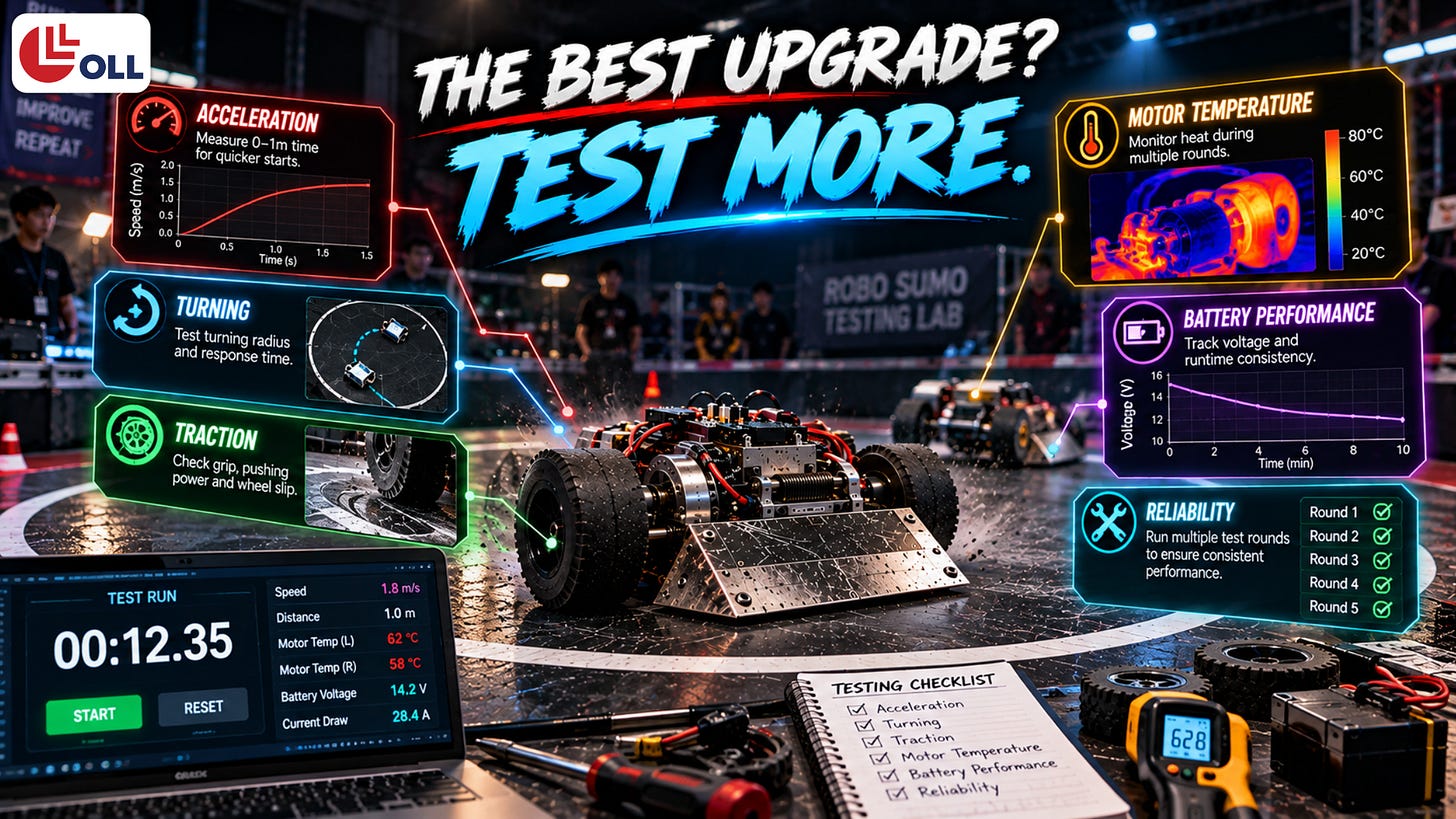
There is one upgrade that costs almost nothing:
Test More.
A participant can spend hours changing components, but without proper testing, it becomes difficult to know whether the robot actually improved.
Create a simple testing routine.
Test 1 — Acceleration
How quickly does the robot reach its operating speed?
Test 2 — Turning
How quickly can it change direction?
Test 3 — Traction
Can the wheels maintain grip when the robot is pushing?
Test 4 — Motor Temperature
Does the motor become excessively hot during repeated matches?
Test 5 — Battery Performance
Does the robot maintain consistent performance as the battery voltage changes?
Test 6 — Reliability
Can the robot complete multiple test matches without a loose wire, overheating component or mechanical failure?
🥊 Upgrade Your Tactics, Not Just Your Hardware
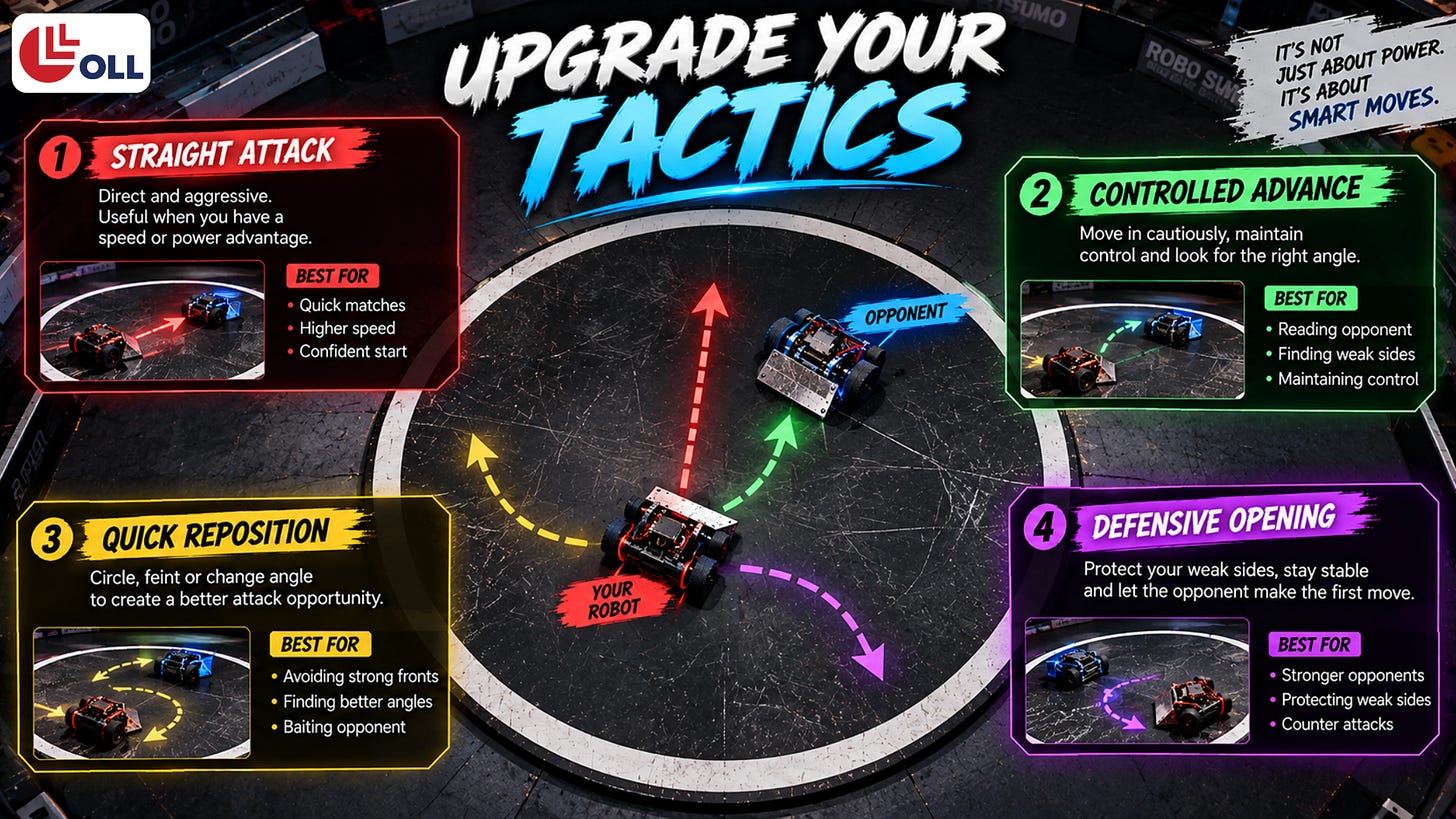
A powerful robot still needs a good strategy.
Before a match, think about how the robot will actually be used.
Don’t always attack immediately.
The first movement doesn’t always have to be a full-speed charge.
Understand the opponent’s movement and look for an opportunity.
Protect your weak side.
If one side of the robot has less traction or a vulnerable mechanical component, avoid exposing it unnecessarily.
Use traction intelligently.
Having powerful motors doesn’t help if the wheels can’t transfer that power to the arena.
Practise different opening moves.
Try different starting strategies during practice:
Straight attack
Controlled advance
Quick reposition
Defensive opening
Then determine which strategy works best for the robot.
🔥 The Upgrade Formula
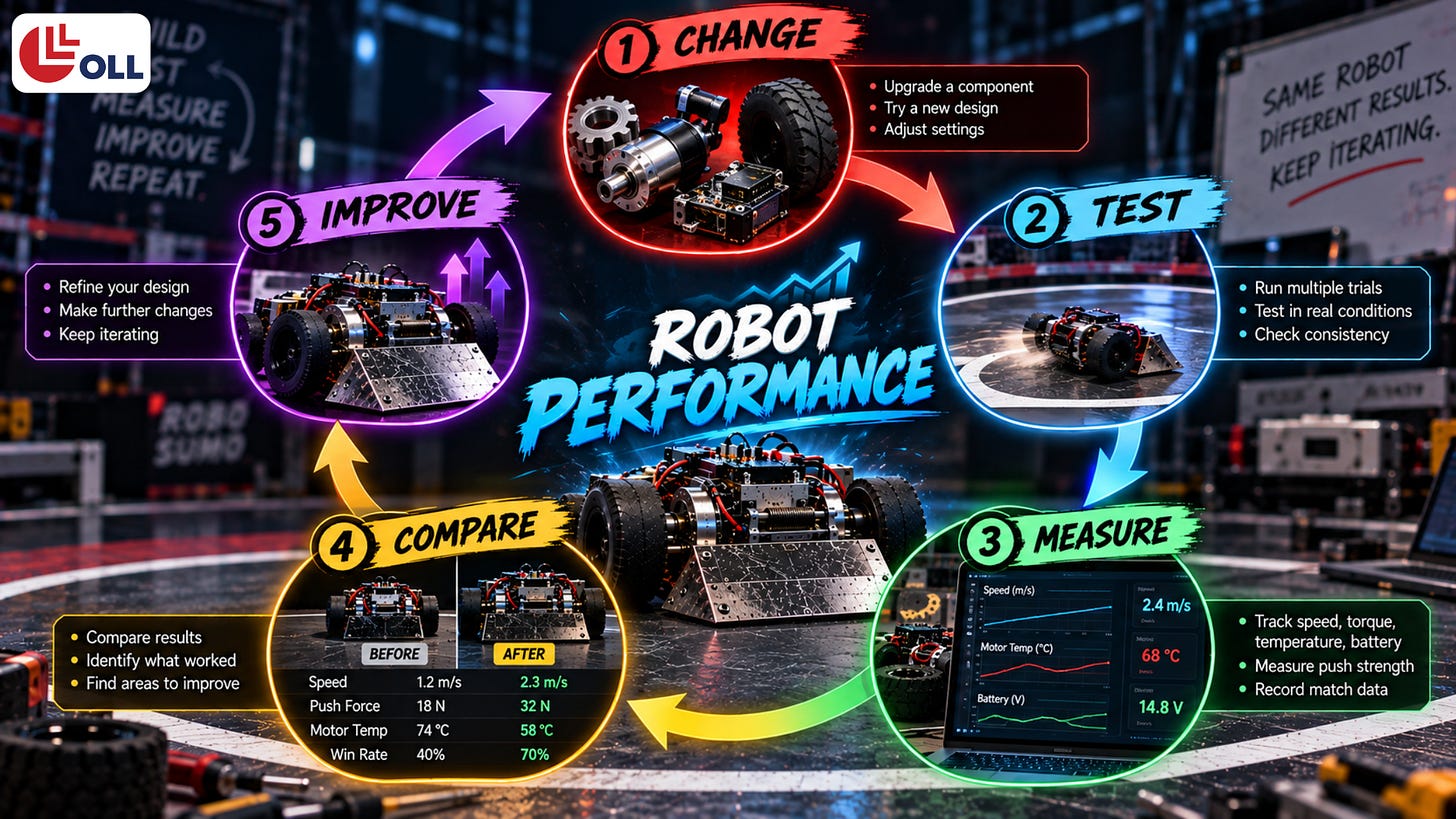
Instead of randomly replacing components, use this simple approach:
CHANGE → TEST → MEASURE → COMPARE → IMPROVE
For example:
Change: Bigger wheels
↓
Test: Run the same pushing test
↓
Measure: Speed, traction and motor temperature
↓
Compare: Before vs after
↓
Improve: Keep the upgrade only if performance actually improves
This turns robotics into an engineering process rather than guesswork.
🏆 What Makes a RoboSumo Competitive?
There isn’t one component that automatically creates a winning robot.
A competitive RoboSumo is the result of several systems working together:
⚡ Power
Enough power to drive the motors effectively.
🛞 Traction
Enough grip to transfer motor power to the arena.
🧱 Mechanical Design
A strong and stable structure.
💻 Control
Fast and predictable responses.
🔌 Electronics
Reliable connections and appropriate components.
🧠 Strategy
A driver or control system that knows when to attack, reposition and defend.
🧪 Testing
Continuous experimentation before competition day.
⚠️ Don’t Upgrade Blindly
One of the biggest mistakes participants can make is assuming that more powerful = better.
A bigger motor may consume more current.
A bigger wheel may reduce effective pushing torque.
A faster motor may make the robot harder to control.
A more powerful motor driver may require a different power system.
A new microcontroller may require completely different code.
A brushless motor may require an ESC and a different control architecture.
So every upgrade should answer one question:
What problem am I trying to solve?
If the robot is slipping, work on traction.
If it is slow to accelerate, investigate the motor and power system.
If it turns poorly, look at wheel alignment, control and weight distribution.
If the robot behaves unpredictably, investigate the code and electronics before adding more hardware.
🛒 Looking for RoboSumo Components?
Building or upgrading a RoboSumo robot requires the right motors, electronics, wheels and mechanical components.
Explore the RoboSumo Competition Kit from OLL to get the components needed to start building.
🚀 Final RoboSumo Upgrade Checklist
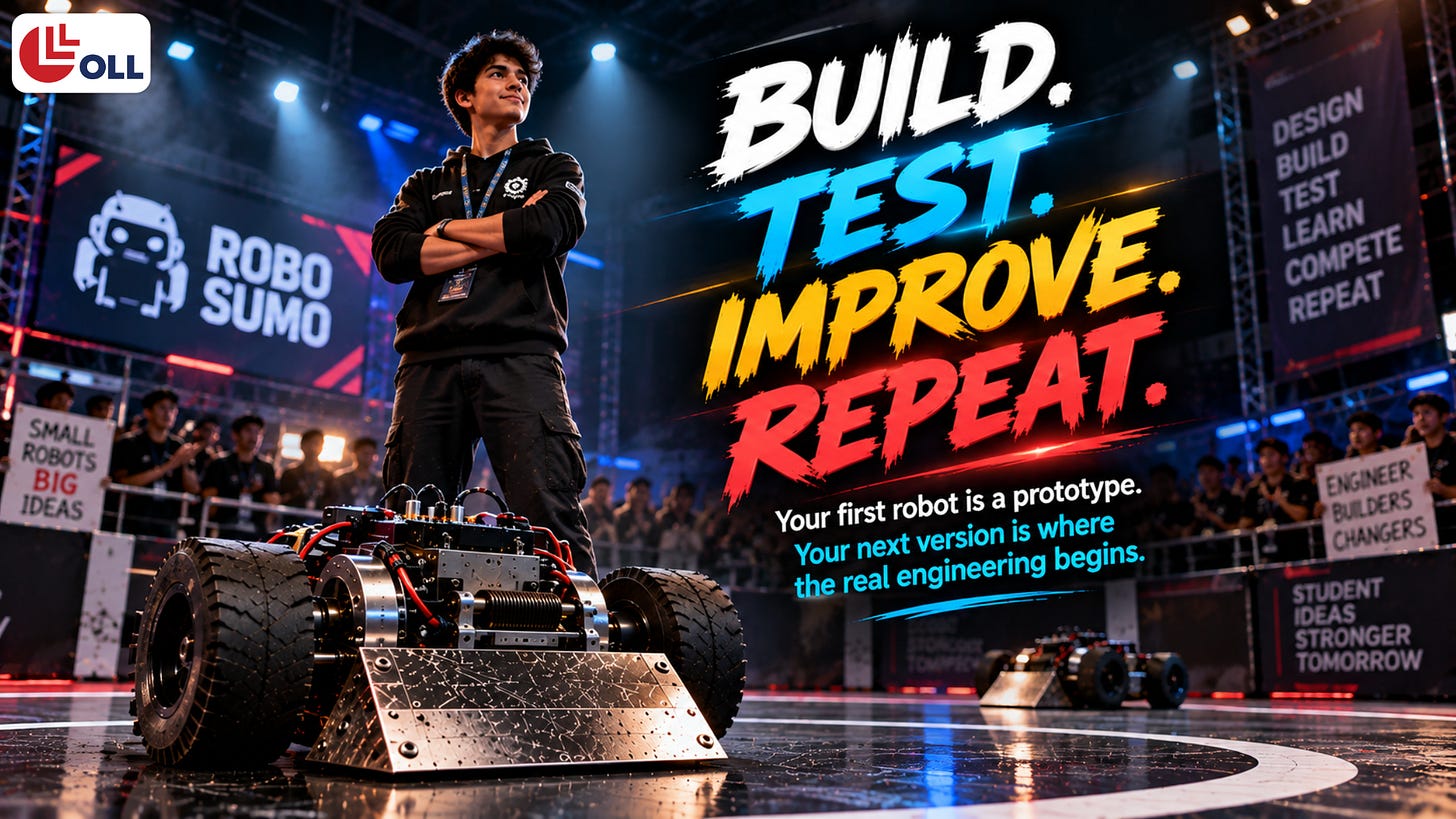
Before finalising the robot, ask:
☐ Have different motors been tested?
☐ Has the control code been optimised?
☐ Has wheel size and traction been tested?
☐ Have motor-driver options been evaluated?
☐ Has the MCU been selected based on actual requirements?
☐ Has the power system been tested under load?
☐ Are all electrical connections secure?
☐ Has the robot been tested repeatedly?
☐ Has the robot been tested against different opponent designs?
☐ Does the final design comply with the official competition rules?
🔗 More Robotics Resources from OLL
🤖 Build Your First RoboSumo
Complete step-by-step guide to building a RoboSumo robot.
🏎️ Build a RoboRacer
Learn how to build and prepare a RoboRacer for robotics competitions.
🏆 Robotics Competitions for School Students
Explore robotics competitions and opportunities for young innovators.
📚 Robotics Learning Pathway
A step-by-step roadmap from learning robotics fundamentals to competition.
🛒 RoboSumo Competition Kit
Get the components needed to start building your RoboSumo robot.
🚀 OLL × TechFest Robotics Championship
Explore the official OLL × TechFest 2026–27 competition.
Build. Test. Improve. Repeat.
How to Learn Robotics / Robotics Learning Pathway
Not sure where to start with robotics? Follow OLL’s robotics learning pathway to go from learning the fundamentals to building projects, testing robots and participating in competitions.
The best part of RoboSumo isn’t simply building a robot.
It’s discovering why one design performs better than another.
Try a different motor.
Change the code.
Experiment with the wheels.
Test a new control system.
Measure the result.
Then improve it again.
Don’t just build the first robot that works. Build, test and engineer a robot that performs. 🤖⚔️
And most importantly, don’t copy someone else’s winning design.
Use these ideas as starting points, experiment with your own approach and create a RoboSumo that reflects your own engineering decisions and creativity.
Your first robot is a prototype. Your next version is where the real engineering begins.
🏎️ Interested in RoboRacer?
If speed and precision are more your style, check out the complete RoboRacer robot building guide and learn how to build and prepare a RoboRacer for robotics competitions.
Frequently Asked Questions
How can I make my RoboSumo robot more competitive?
A competitive RoboSumo depends on several factors including motor performance, traction, mechanical design, control, electronics, strategy and testing.
What motor is best for a RoboSumo robot?
There isn’t one universally best motor. Motor selection should consider torque, RPM, current consumption, weight, acceleration and compatibility with the rest of the power system.
How can I improve RoboSumo traction?
Experiment with wheel material, tread pattern, wheel size, weight distribution and contact with the arena surface while staying within the competition rules.
Can I use different motors in my RoboSumo?
Different motors can be tested as part of the development process, but the final configuration must comply with the official competition rules.
How do I prepare my RoboSumo robot for a competition?
Test acceleration, turning, traction, battery performance, motor temperature, reliability and performance against different opponent designs.
What should I upgrade first on a RoboSumo robot?
Start by identifying the actual weakness of the robot. For example, slipping may require traction improvements, while poor acceleration may require investigating the motor and power system.
🚀 Ready to Take Your RoboSumo to the Next Level?
Building a RoboSumo robot is more than assembling motors and electronics. It’s about designing, testing, solving problems and improving through experimentation.
Take what you’ve learned and put it to the test through the OLL × TechFest Robotics Championship 2026–27.
Build. Test. Improve. Compete.