Krutansh TikiwalaKapol Vidyanidhi International School
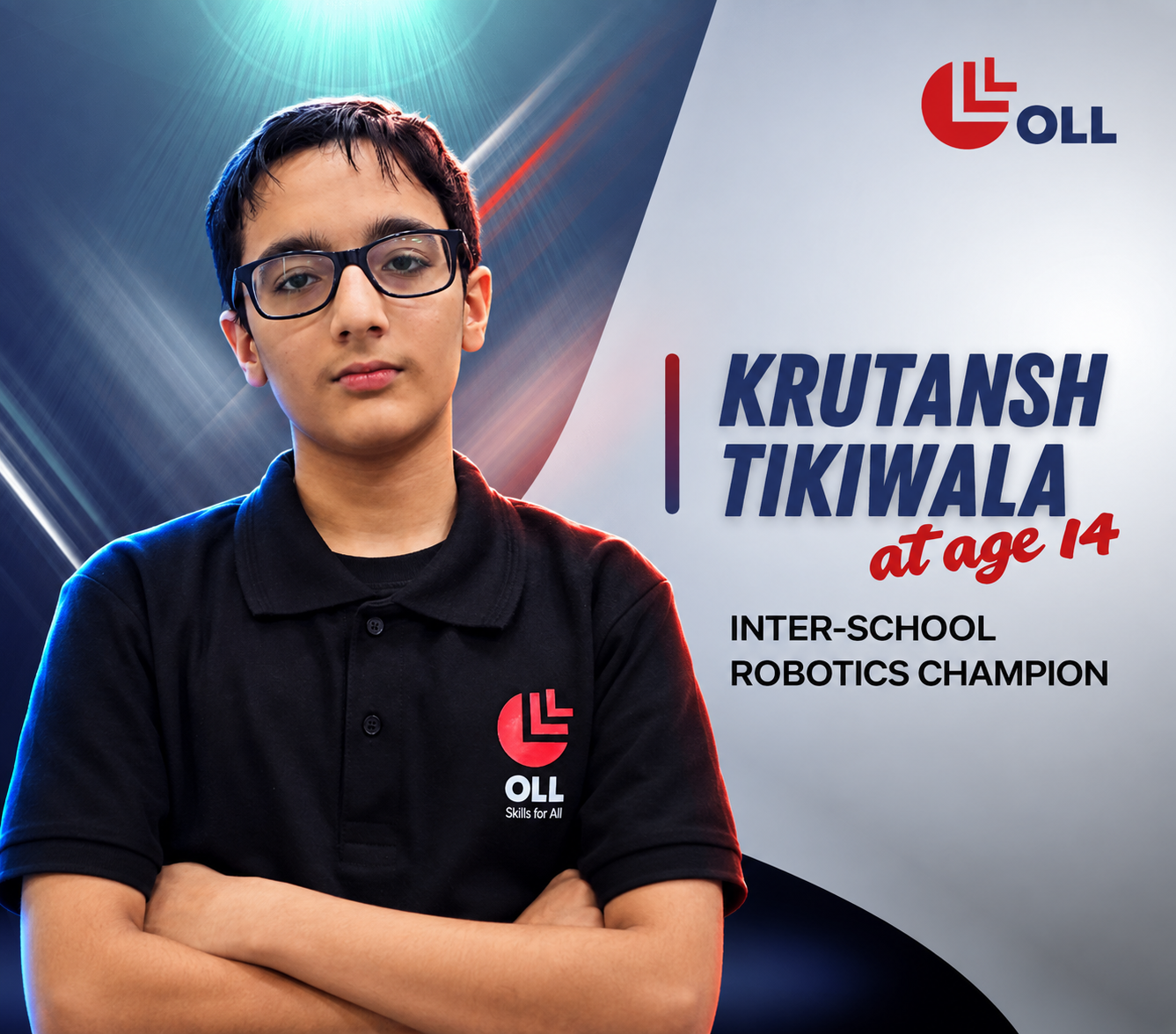

The Making of a 14-Year-Old Robotronix 2026 First-Prize Winner
My Backstory
My name is Krutansh Tikiwala, and I am a 14-year-old student currently studying in Grade 9 at Kapol Vidyanidhi International School. I am passionate about robotics, artificial intelligence, electronics, programming, and engineering.
My interest in technology developed through hands-on learning and robotics projects. I have always been fascinated by understanding how machines work and, more importantly, by creating something of my own. Over time, I began exploring robotics, sensors, programming, electronics, AI, and automation through different projects and competitions.
I strongly believe that the best way to learn engineering is not just by studying concepts, but by building, experimenting, making mistakes, and improving.
Every project has taught me something different. Sometimes the challenge has been programming, sometimes electronics, and sometimes simply figuring out why something that worked yesterday suddenly stopped working. These experiences gradually helped me become more confident in solving problems independently.
The Journey to Robotronix 2026
My latest competition was Robotronix 2026, based on the theme “Technology for National Safety.” For this competition, I decided to build a project that combined my interests in robotics and AI.
I developed AI Smart Border Sentinel, a prototype intelligent surveillance system designed to demonstrate how AI, robotics, sensors, and automation can work together to support safer border monitoring.
I wanted the project to be more than a simple sensor connected to an Arduino. My goal was to create a complete system with multiple stages: detection, scanning, AI analysis, alerting, and human control.
The project consisted of two main units: the Border Sentinel and the Control Center.
The Border Sentinel used an ultrasonic sensor to monitor its surroundings. When an unidentified entity like a person or a vehicle entered the detection range, the system automatically switched from normal monitoring to scanning mode. A servo motor moved the surveillance camera across different directions, allowing the system to observe the area.
The AI vision system formed another important part of the project. Instead of relying on a single sensor, I wanted the system to demonstrate how multiple technologies could work together to make surveillance more intelligent.
The Control Center provided the operator with information about the system’s status. I used an RGB indicator where blue represented normal monitoring, yellow represented scanning, and red represented an alert. An LCD displayed information, while dual buzzers provided an audible warning. I also incorporated manual controls so that the operator could control the surveillance direction.
Building, Testing and Troubleshooting
Turning the idea into a working prototype was not straightforward.
The biggest part of the development process was testing. Sensors sometimes behaved differently from what I expected, connections had to be checked repeatedly, and the program needed to coordinate several components simultaneously.
Initially, I experimented with different approaches for detecting movement. When the first approach was not giving me the reliability I wanted, I changed the detection method and used an ultrasonic sensor instead. This required modifying the wiring, programming logic, and overall system behaviour.
I also worked on the alert system. Instead of making every detection immediately behave identically, I created an escalating alert concept. Repeated confirmed alerts within a short period could increase the threat level, causing the alarm pattern to become faster. This made the prototype demonstrate a more structured response rather than simply switching a buzzer on and off.
The project went through multiple rounds of testing. I had to make sure that the servo, ultrasonic sensor, AI vision system, RGB indicator, LCD, buttons, and buzzers could work together without interfering with each other.
The Biggest Challenge
Then came the moment that tested me the most. Just 15 minutes before my chance to present the project, the power bank suddenly stopped working. After spending so much time building and preparing the project, suddenly having no power just before the presentation was extremely stressful. There was almost no time left.
Instead of giving up or assuming that the project could not be demonstrated, I immediately started troubleshooting. I checked the power arrangement and worked on getting the system running again.
With only minutes remaining, I managed to get the project working. That experience reminded me that a competition project isn’t truly finished until you can make it work when something unexpected happens.
The Competition Day
When it was finally my turn, I demonstrated AI Smart Border Sentinel and explained the concept, the technologies involved, and how the different components worked together.
I explained the complete process:
Detect → Scan → Analyse → Respond
The presentation was not simply about showing that the robot worked. I wanted to communicate the engineering behind it and explain why I had designed the system in that particular way. After months of learning, designing, programming, wiring, testing, troubleshooting, and improving, the moment finally arrived.
🥇 FIRST PRIZE — ROBOTRONIX 2026
Hearing that I had won First Prize was an incredible moment.
The trophy represented much more than the final presentation. It represented every failed test, every debugging session, every design decision, and especially the last-minute crisis when the power bank stopped working.
What I Learnt, and What’s Next?
Robotronix taught me that engineering is not about getting everything right on the first attempt. It is about identifying a problem, building a solution, testing it, finding weaknesses, and continuously improving it.
The power-bank failure taught me another important lesson: reliability matters just as much as innovation. A great idea is valuable only when you can make it work consistently.
Building AI Smart Border Sentinel also strengthened my interest in combining AI, robotics, electronics, programming, and engineering. I enjoy projects where different fields come together to create something functional.
Winning First Prize has motivated me to take on even more challenging projects and competitions. I want to continue developing my technical skills, learning new technologies, and building systems that go beyond demonstrations.
My goal is not simply to collect trophies. I want every competition and every project to teach me something new and push me closer to becoming an engineer and innovator capable of creating technology that can solve meaningful real-world problems.
One idea. Countless tests. One last-minute crisis. One First Prize. And this is only the beginning.
Shared by Krutansh Tikiwala