Introducing ICSE Robotics and Artificial Intelligence (Subject Code 66) in Classes 9 and 10 takes more than adding another subject to the timetable. Schools need to plan curriculum, the Robotics & AI lab, teacher support, practical activities and internal assessment together, from the first week of the academic year.
In this guide
- Why CISCE introduced Code 66
- Should your school introduce it?
- What CISCE expects from schools
- How Code 66 is assessed
- Structuring assessments across the year
- Recommended assignments
- Lab infrastructure
- Connecting every practical to a concept
- Choosing a curriculum provider
- Class 9 & 10 curriculum breakdown
- Recommended books
- Selecting the right teacher
- How OLL supports implementation
- Real student results
- Schools already using OLL Code 66
- Readiness checklist
- FAQs
Rationale
Why did CISCE introduce Code 66?
The CISCE aims of the programme are to:
- Develop an understanding of concepts and applications in Robotics and Artificial Intelligence.
- Build competencies via classroom instruction, laboratory learning and self-directed project-based work.
- Facilitate hands-on application of concepts through practical activities.
- Instill AI-readiness skills through Data, Computer Vision and Natural Language Processing.
- Introduce the AI Project Framework.
- Familiarise students with computational skills (basic Python coding).
- Create awareness of the ethical considerations of AI.
Decision
Should your school introduce this subject? Yes — here's why.
- Build practical technology skills. ICSE Robotics & AI moves students beyond theory into working robotics, programming, AI and hands-on projects.
- Develop future-ready competencies. The subject combines Robotics, AI, Python, Data and computational thinking — increasingly relevant across technology-driven fields.
- Encourage learning through projects. Students experiment, build, test and apply rather than memorise.
- Offer a structured ICSE pathway. Instead of occasional workshops, Robotics & AI runs as a proper ICSE Group 3 subject with a defined curriculum, practical work and assessment framework.
CISCE Framework
What does CISCE expect schools to do?
The CISCE Robotics and AI syllabus is built around a mix of classroom instruction, laboratory learning and project-based work. Six operational responsibilities sit with the school:
- Getting students to opt for the programme. Introduce the subject, its learning areas and practical applications so students make an informed choice.
- Identifying and training the right teacher. Ensure the teacher is adequately trained on concepts, curriculum, practical activities and resources.
- Arranging a curriculum provider. Books, structured lesson plans, instructional videos and other resources are all required.
- Purchasing materials for practicals. Robotics kits, controllers, sensors, motors and other components for hands-on activity.
- Implementing Robotics & AI in the timetable. Allocate regular periods for both instruction and practical work.
- Regular assessment. Tests, examinations, practical assessments and project-based evaluation across theory and practice.
Assessment
How is Code 66 assessed?
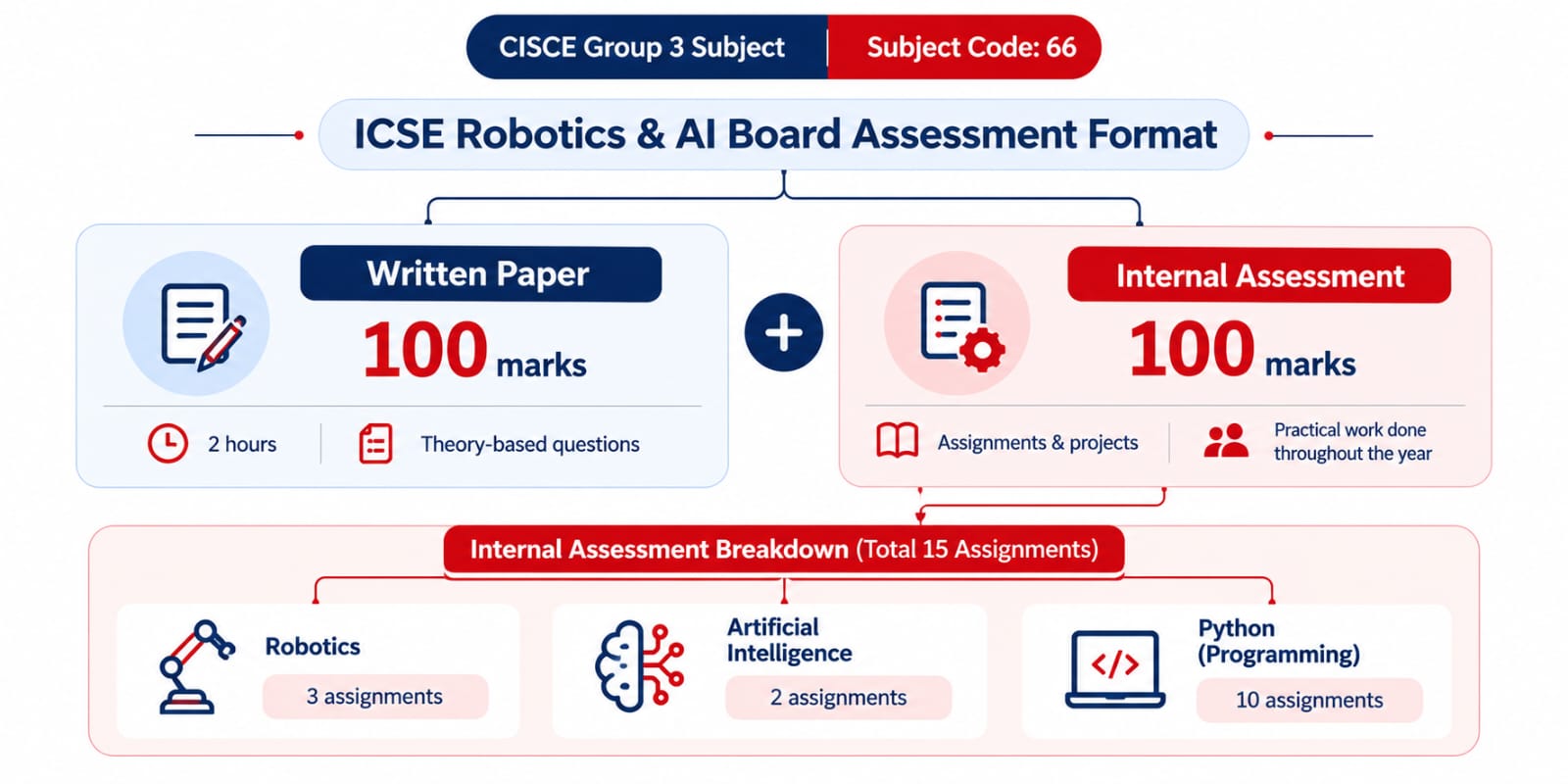
The prescribed ICSE Robotics & AI exam pattern gives equal weight to theory and practice: a two-hour written paper of 100 marks, and 100 marks of internal assessment.
Because half the marks come from internal assessment, year-round implementation matters. CISCE sets a minimum number of assignments for each class:
Year plan
How should schools structure assessments through the year?
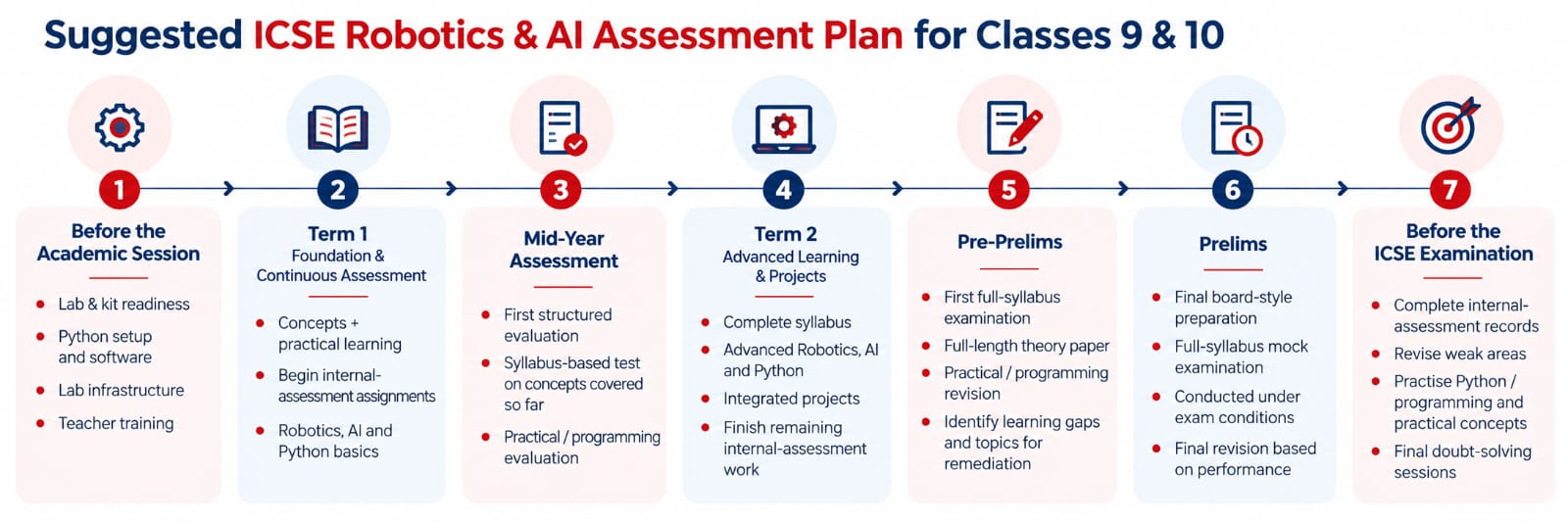
1. Before the academic session
- Lab & kit readiness
- Python setup and software
- Lab infrastructure
- Teacher training
2. Term 1 — foundation & continuous assessment
- Concepts + practical learning
- Begin internal-assessment assignments
- Robotics, AI and Python basics
3. Mid-year assessment
- First structured evaluation
- Syllabus-based test on concepts covered
- Practical/programming evaluation
4. Term 2 — advanced learning & projects
- Complete syllabus
- Advanced Robotics, AI and Python
- Integrated projects
- Finish remaining IA work
5. Pre-Prelims
- First full-syllabus examination
- Full-length theory paper
- Practical/programming revision
- Identify learning gaps for remediation
6. Prelims
- Final board-style preparation
- Full-syllabus mock exam under exam conditions
- Final revision based on performance
7. Before the ICSE exam
- Complete IA records
- Revise weak areas
- Practise Python/programming
- Final doubt-solving sessions
Practicals
Recommended assignments & practical activities
The CISCE-suggested assignments mix Robotics, AI and Python Programming, with increasing complexity across Grades 9 and 10.
Grade 9
Robotics.
- Identify and present 5 unique smart robots and their applications.
- Explain: "All robots are machines, but all machines are not robots."
- Create a mind map of features, applications and classification of robots.
Artificial Intelligence.
- Explore how AI can be used in classrooms and how teaching could change in an AI-enabled classroom.
- Discuss how AI can be a blessing or a curse, with relevant examples.
- Use the AI Project Framework to design a Smart School — attendance, homework, fees, library.
Python Programming.
- Create a mind map of Python data types with examples.
- Explore uses of Python functions and modular programming.
- Explain different types of errors in Python.
- Write programs using
whileloops. - Find the larger of two numbers, prime/composite, HCF and LCM.
- Print: "AI is a Powerful Tool; however, it is to be used with Discretion."
Grade 10
Robotics.
- Presentation on machine vs. robot vs. cobot.
- How is technology evolving, and how does it impact us?
- Are smart systems making humans less smart?
- Report on robotic systems in different areas of life.
Artificial Intelligence.
- Concept map for a Smart Transport Management System for a school.
- Design an AI-enabled Query Management System using the AI Project Framework.
- Ideas for implementing AI across a school using the AI Project Framework.
Python Programming & Data Analysis.
- Work with lists, strings and dictionaries on real-world datasets.
- NumPy arrays: indexing, slicing, searching, sorting, reshaping.
- Pandas for CSV / JSON.
- Matplotlib plots, bar graphs, histograms.
- Basic data analysis on real-world datasets.
- Regression, trend analysis and predictions.
- Normal distribution + analysing student scores (mean, median, mode).
- Python programs for real-world applications: electricity bills, employee bonuses.
Lab
What infrastructure does a Robotics & AI lab need?
An ICSE Robotics & AI lab needs both a digital and a physical layer. Students need computers with a Python programming environment, the right robotics hardware and access to simulation tools.
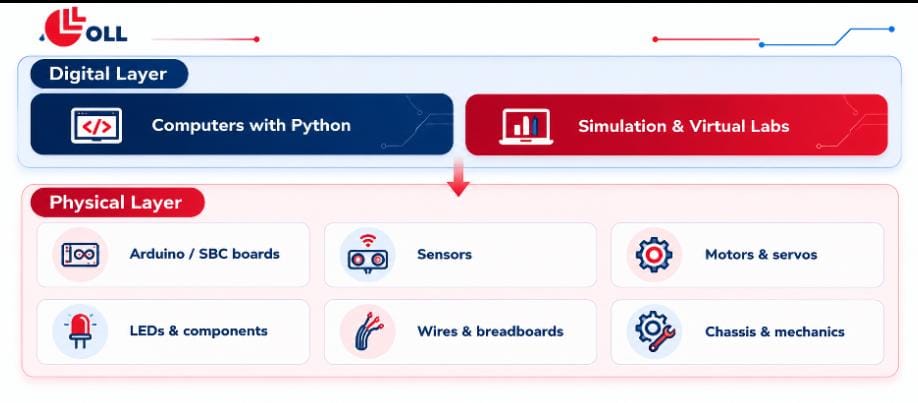
Depending on the school's model, a robotics kit for schools may include:
- Robotics boards such as Arduino or other single-board systems
- Sensors, motors and servo motors
- LEDs and electronic components
- Wires and breadboards
- Robotics chassis and mechanical components
- Simulation and virtual laboratory environments
- Computers with Python installed / OLL's Virtual Python IDE
The real question isn't how many components you buy. It is whether those components are enough for every activity your students are expected to perform across Class 9 and Class 10.
Pedagogy
Connect every practical to a concept
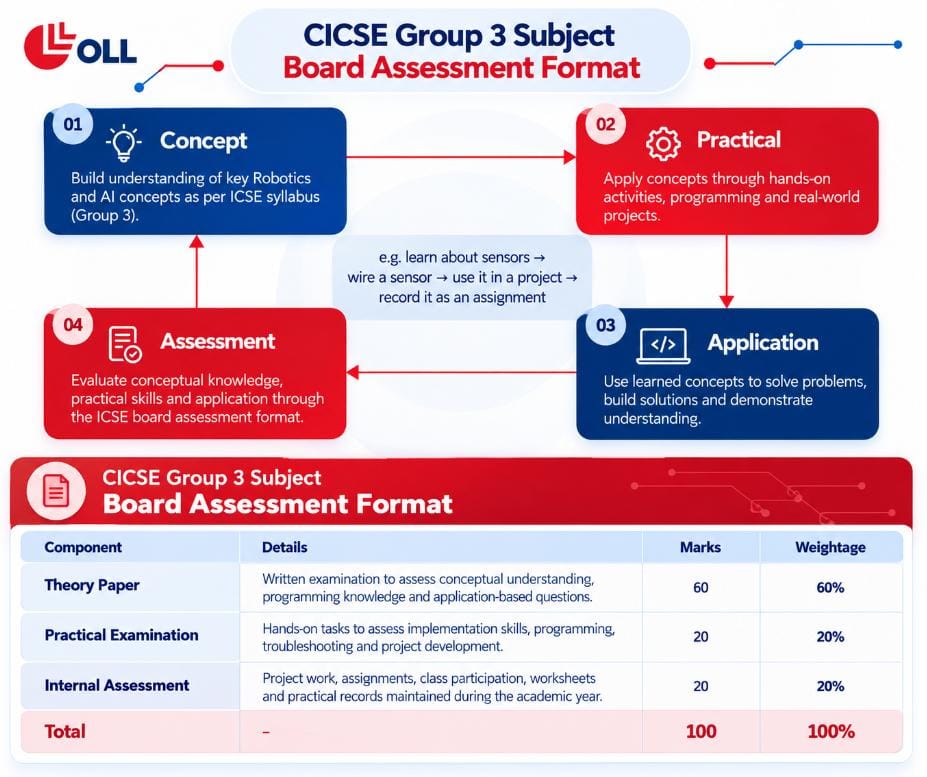
Practical work should not be an occasional workshop. It works best when it follows directly from what was just taught. After learning about sensors, students work with sensors. After learning programming concepts, they write and test code. After learning about robotic systems, they combine components into a working project.
Vendor evaluation
How to choose an ICSE Robotics & AI curriculum provider
Choosing the right curriculum provider is about more than a textbook or a set of robotics kits. Schools need a programme aligned with the CISCE framework while making Robotics, AI and Python practical, engaging and easy to implement.
When comparing providers, ask five questions:
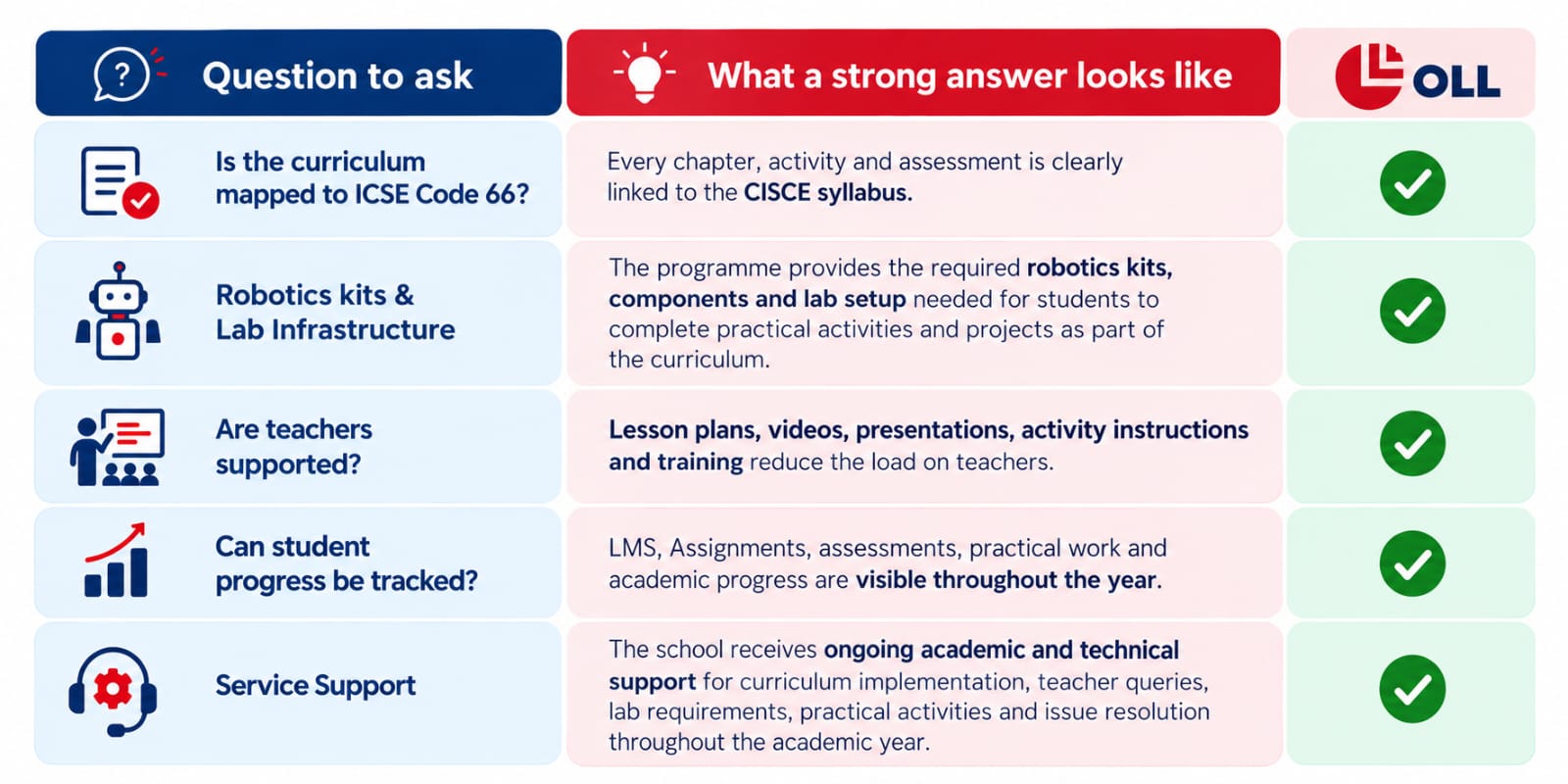
| Question | What a strong answer looks like | OLL |
|---|---|---|
| Is the curriculum mapped to ICSE Code 66? | Every chapter, activity and assessment linked to the CISCE syllabus. | ✓ |
| Robotics kits & lab infrastructure | Required kits, components and lab setup for every practical activity. | ✓ |
| Are teachers supported? | Lesson plans, videos, presentations, activity instructions and training reduce the load on teachers. | ✓ |
| Can student progress be tracked? | LMS, assignments, assessments and practical work visible throughout the year. | ✓ |
| Service support | Ongoing academic + technical support for implementation, teacher queries, lab issues and practical activities. | ✓ |
Syllabus
Class 9 & 10 curriculum — what students actually learn
The CISCE Robotics & AI curriculum for Classes 9 and 10 combines Robotics, Artificial Intelligence and Python Programming. Students move from foundational concepts in Class 9 to more advanced applications, programming and integrated robotic systems in Class 10.
Class 9 — building the foundations
Robotics
- Introduction to Robotics
- Evolution, types, applications
- Laws of Robotics
- Robot components & systems
- Motion, joints, links, DOF
Artificial Intelligence
- Intro & applications
- Data and information
- Evolution of computing
- AI ethics, bias, fairness
- Computer Vision, NLP, Neural Networks
- AI Project Cycle
Python
- Python fundamentals
- Data types & variables
- Operators
- Conditional statements
- Loops and functions
Assessment: Minimum 15 assignments covering Robotics, AI and Python.
Class 10 — advancing skills and applications
Robotics
- New-age robotic systems
- Drones, autonomous vehicles, healthcare robots
- Cobots & human-robot interaction
- Gears, sensors, actuators, controllers
- Robotic design in Tinkercad
- Integration of robotic systems
Artificial Intelligence
- Machine & computer decision-making
- Automated & autonomous systems
- Introduction to Machine Learning
- Machine intelligence
- Cybersecurity & AI ethics
- Advanced AI Project Cycle
Python
- Modules & packages
- NumPy, Pandas, SciPy, Matplotlib
- Lists, tuples, strings
Assessment: Minimum 20 assignments covering Robotics, AI and Python.
Resources
Books for Class 9 & 10 ICSE Robotics & AI
- OLL — ICSE Code 66-focused Robotics & AI books for Classes 9 and 10, combining theory with practical activities, Python, AI and robotics projects. Includes lesson plans, videos, assessments and practical kits. Buy from OLL
- Orange Publication — Robotics & AI learning books for ICSE students with structured chapters and activities.
- KIPPS — ICSE-focused Robotics & AI resources designed to help students understand concepts and prepare for assessments.
- STEMpedia — Robotics, AI and STEM resources with a practical, project-based approach.
Staffing
Selecting the right teacher for Code 66
Educational background.
- Preferably a graduate/postgraduate in Computer Science, IT, Electronics, Engineering, Physics, Mathematics, STEM Education or a related field.
- Basic understanding of coding, computational thinking, robotics and technology.
- A formal Robotics/AI degree is not essential if the teacher has the right technical aptitude and willingness to learn.
Teaching & STEM/Robotics experience.
- Prior teaching experience in Computer Science, STEM, Robotics, Coding or AI is preferred.
- Experience conducting practical sessions and projects is an advantage.
- Comfort with robotics kits, sensors, motors, programming tools and AI-based activities.
- Ability to explain technical concepts in a simple, student-friendly manner.
Full implementation
How OLL supports ICSE Robotics & AI implementation
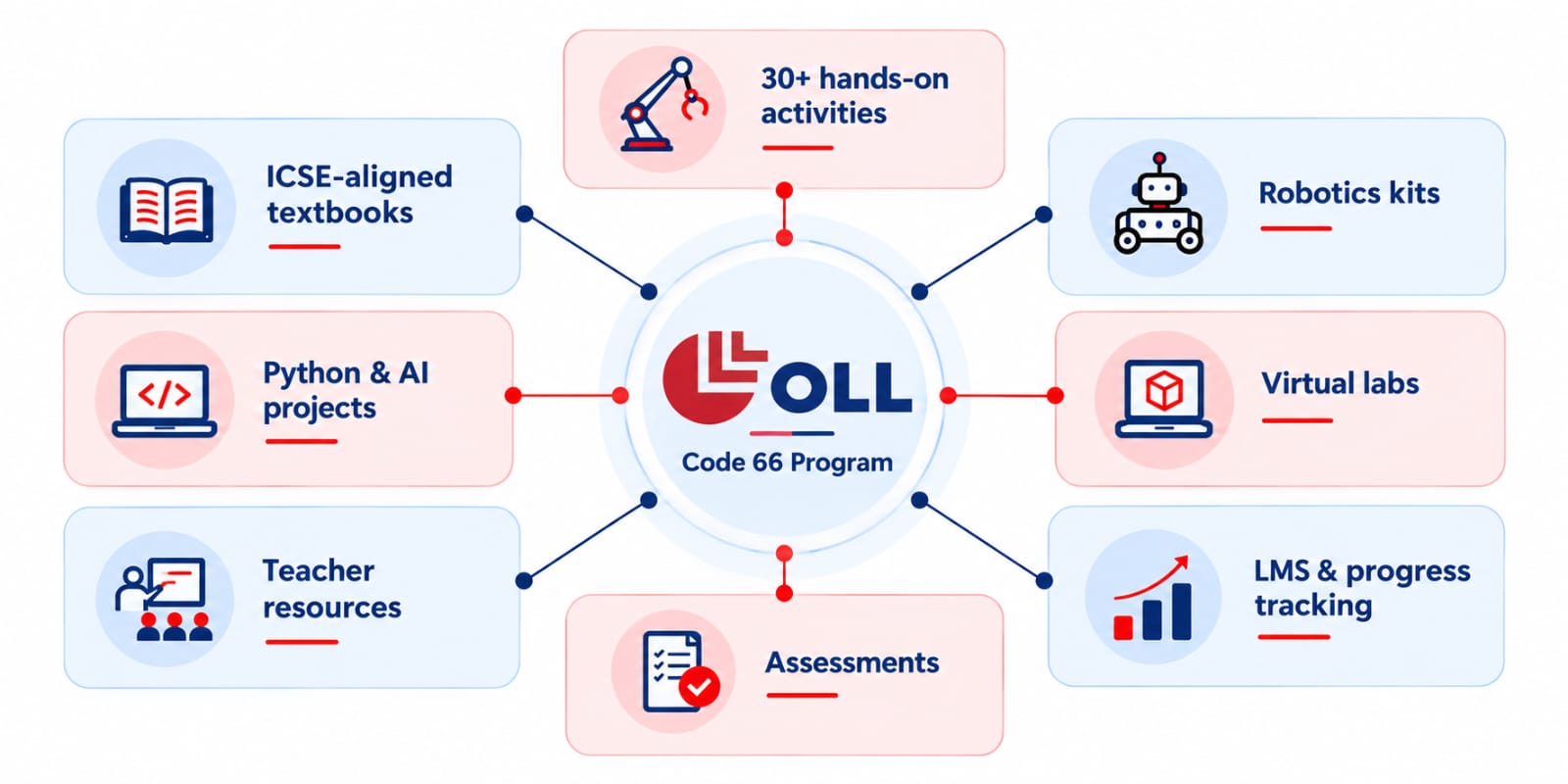
OLL's ICSE Robotics & AI programme for Classes 9 and 10 is an integrated school solution, not just a textbook or a hardware package. It brings together:
- ICSE-Aligned Curriculum & Textbooks — Class 9 & 10 books mapped to Code 66.
- 30+ Hands-on Activities — practical activities across Robotics, AI and Python.
- Complete Robotics Kits — Arduino, sensors, motors and all required hardware.
- Python, AI & Machine-Learning Projects — apply Python, AI and ML in real projects.
- Assessments — quizzes, assignments, practical assessments and tests.
- LMS & Progress Tracking — student-wise progress across the year.
- Virtual Labs & Online Python IDE — practise from any computer with internet, no install.
OLL Code 66 Program
ICSE Robotics & AI · Class 9 & 10
A ready-to-run implementation: books, 36-item kits, Python IDE, LMS, assessments and teacher training — all mapped to CISCE Code 66.
See the Program- ICSE-aligned textbooks (9 & 10)
- 36-item Robotics & AI Lab Kit
- Virtual Python IDE (browser)
- LMS + student progress tracking
- Lesson plans, videos, worksheets
- Assessments + IA framework
Impact
Real student results from OLL Code 66
OLL students have shown consistent strength in ICSE Robotics & AI, with several scoring 95+ including multiple perfect 100/100s.
Students who scored 100/100
| Student | School | Grade | Result |
|---|---|---|---|
| Anany Abhay Srivastava | N. L. Dalmia High School | ICSE X | 100/100 |
| Aashlesha Dhanraj Kotian | N. L. Dalmia High School | ICSE X | 100/100 |
| Hinesh Komal Nyati | N. L. Dalmia High School | ICSE IX | 100/100 |
| Ranveer Mukesh Singh | N. L. Dalmia High School | ICSE IX | 100/100 |
| Krishang Udasi | Sanjeevani World School | ICSE X | 100/100 |
Complemented by several high scores — Isha Dipen Chokshi (ICSE X · 100), Lakshanya Panwar (ICSE X · 99), Deeveesha Vijay Bhatt (ICSE IX · 99), Mahika Amitkumar Sankhe (ICSE IX · 98), Ayaan Ashish Singh (ICSE IX · 98) — the pattern is not a handful of toppers but a whole cohort clearing 90+.
Adoption
Schools already running OLL Code 66
Several schools have adopted OLL Code 66 as a third-subject option for ICSE students, bringing Robotics & AI into the regular academic curriculum with kits, teacher resources, assessments and LMS-based learning.
- N. L. Dalmia High School
- Sanjeevani World School
- Seven Eleven Scholastic School, ICSE
- Fravashi International Academy
- Loretto Convent School, Lucknow
Ecosystem at a glance: 400+ schools, 1,47,500+ students, 35+ cities.
Get ready
ICSE Robotics & AI readiness checklist for schools
Before the academic year begins, make sure your school has clarity on each of these:
- Student and parent communication
- Curriculum & syllabus mapping / provider selection
- Timetable and instructional hours
- Laboratory infrastructure
- Robotics kits & component availability
- Python environment
- Teacher selection
- Teacher training
- Practical activity plan
- Internal assessment schedule
- Student project documentation
- Examination preparation
Planning these early keeps the subject from becoming rushed or overly theory-focused later in the year.
Ready to implement Code 66?
Bring OLL's ICSE Robotics & AI to your school.
Curriculum, robotics kits, virtual labs, teacher resources and LMS — mapped to CISCE Code 66 and running in 400+ schools.
FAQ
Frequently asked questions
What is ICSE Robotics and Artificial Intelligence Code 66?
Code 66 is the CISCE subject code for Robotics and Artificial Intelligence in ICSE Classes 9 and 10. It combines classroom instruction, lab work and projects across robotic systems, components, motion, AI, data, Python programming and AI project frameworks.
How is ICSE Robotics and AI assessed?
Through a two-hour written paper of 100 marks and an internal assessment of 100 marks — theory and practical carry equal weight.
How many assignments are required in Class 9 and Class 10?
A minimum of 15 assignments in Class 9 across Robotics (3), AI (2) and Python (10), and a minimum of 20 in Class 10 across Robotics (4), AI (4) and Python (12).
What equipment is needed for an ICSE Robotics and AI lab?
Computers with Python, robotics boards such as Arduino, sensors, motors and servos, LEDs and electronic components, wires and breadboards, robotics chassis and mechanical parts, plus simulation or virtual-lab tools.
Does CISCE provide resources for teachers?
Yes. The CISCE Primer on Robotics and Artificial Intelligence for Teachers includes suggested activities, assignments and lesson-planning guidance for Classes IX and X.